From Chaos to Clarity: The Power of Structured & Staged Problem Solving
Author : Fergal Brophy
When students are asked to “solve a real-world problem,” we often assume they know where to start and what to do next. From my 12 years experience as Entrepreneurial Specialist at University College Dublin (UCD) Innovation Academy, this is rarely true—students almost always need clear steps and guidance to tackle complex problems successfully.
Over a century ago, in How We Think (1910), John Dewey outlined a problem-solving process: recognize a problem, investigate it, generate possible solutions, weigh evidence, and test outcomes. Dewey argued that effective problem solving isn’t instinctive—it’s the result of a structured process, guided practice, and continuous iteration.
At Anytime Creativity, problem solving isn’t left to chance—it’s intentionally structured through a clear, repeatable process that blends disciplined thinking, practical tools, and ongoing refinement. This structure defines what students do at each step, while staging carefully controls when and how each step is introduced. The result: complex problems become manageable, engaging, and rich with information that drives deep subject matter understanding and learning.
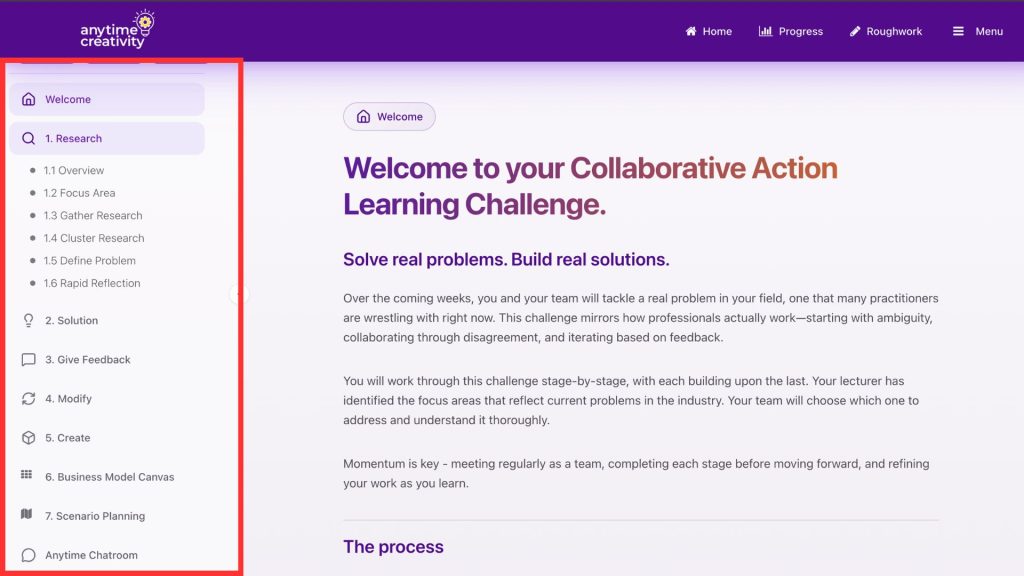
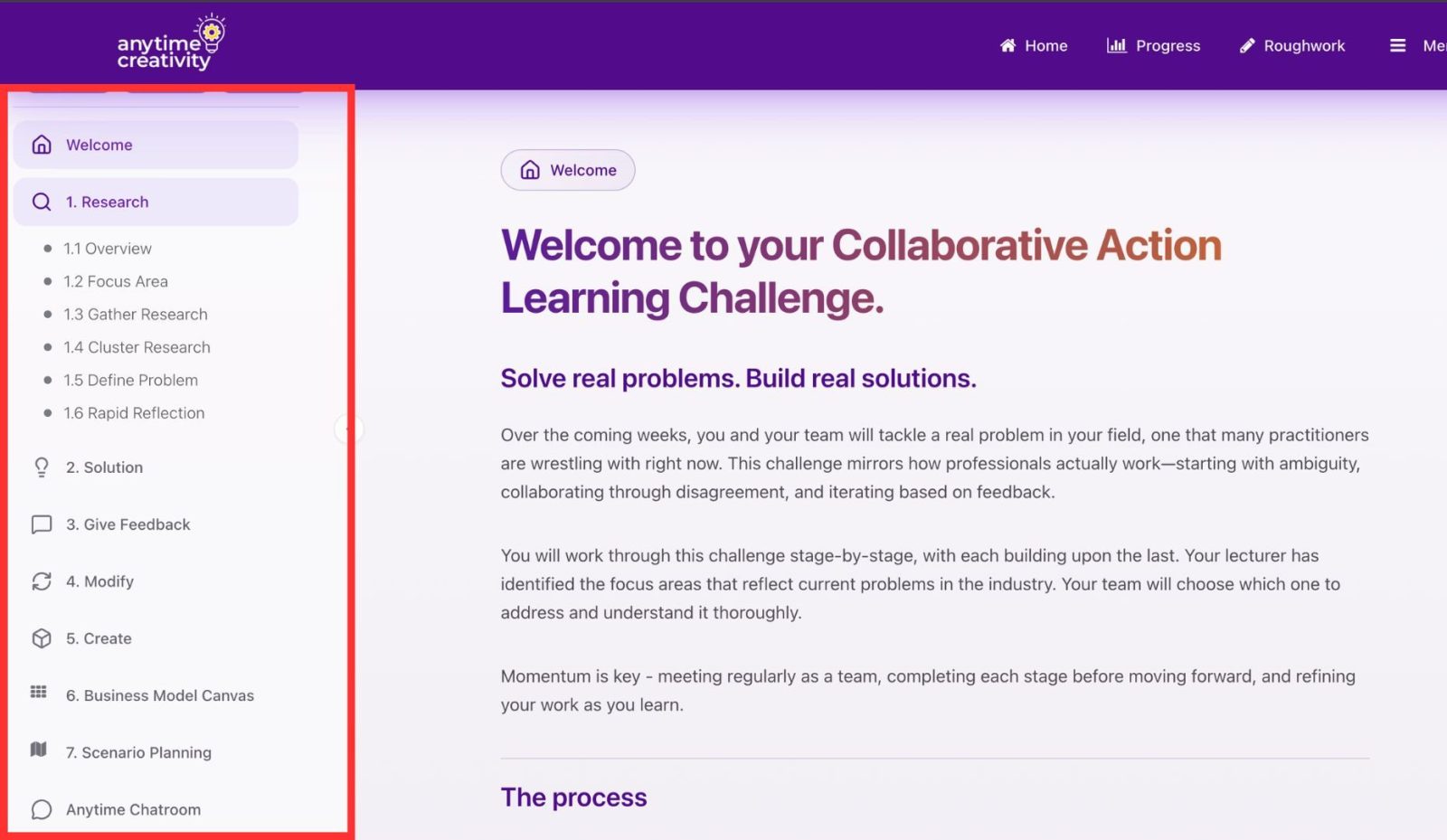
Anytime Creativity platform structure
Why Structure Matters
Without structure, students often jump straight to solutions. They may skip defining the problem, ignore research evidence, or hesitate to share their ideas and embrace feedback. The result is low engagement, poorly developed ideas that students aren’t proud of, and shallow learning.
At Anytime Creativity, a structured design thinking approach guides students seamlessly through each phase, with every step building on the last. Step 1 focuses on understanding the problem and the problem owner, Step 2 on creating diverse solutions before landing on a single solution, Step 3 on receiving feedback from GenAI, peers, and/or experts, Step 4 on iterative improvement based on the feedback, and Step 5 on prototyping & testing. This process is designed to cultivate critical, creative, and agile thinking, transforming complex challenges into deeply learnable experiences.
For educators, the platform makes student progress visible—they can assess not only final outcomes, but the thinking process itself: how students generate insights, create ideas, experiment, adapt, and improve over time as well as how individuals contribute to teamwork.
Platform staging
How Staging Enhances Learning
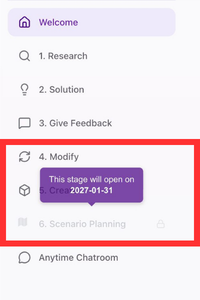
Staging releases the steps gradually, within timed windows. For example, the problem stage might remain open for say a week;
when it closes, the solution stage opens. This ensures that with Anytime Creativity, all students progress together, allowing educators to provide whole-class feedback while students check in on peers’ work in our social-media inspired Chatroom.
Breaking tasks into manageable steps also creates momentum. Students advance stage by stage, collaborating along the way rather than facing one high-stakes challenge, which reduces cognitive overload while building creative confidence, agility and analytical skills.
Deeper Thinking and Learning Outcomes
Structuring and staging problem solving isn’t about adding constraints—it’s about unlocking better thinking and deeper learning. Students gain the tools and mindset to approach complex challenges with confidence, while educators gain clarity to support them effectively.